
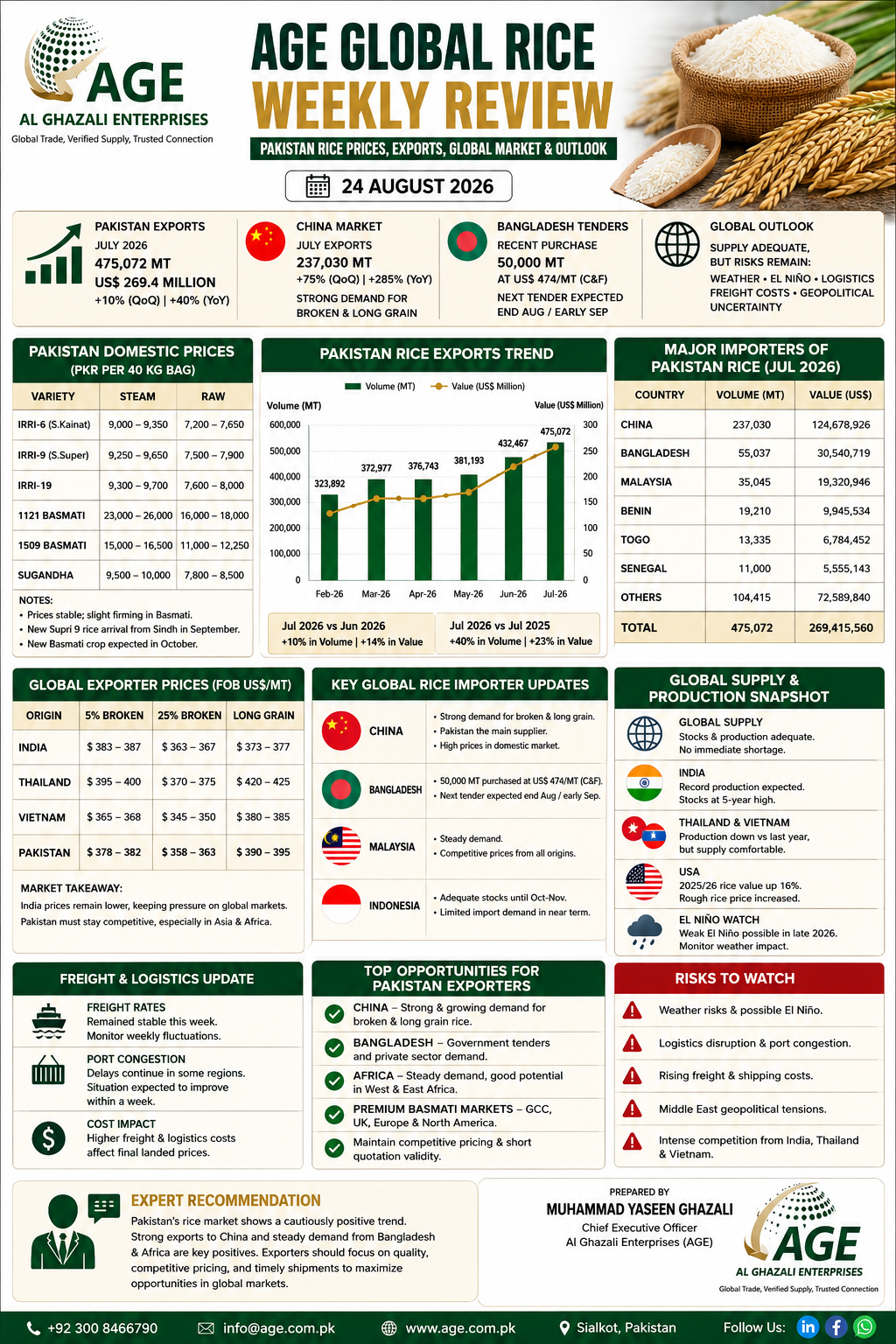
AGE GLOBAL RICE WEEKLY REVIEW
Pakistan & International Rice Market Review Week Ending: 24 August 2026 Published by Al Ghazali Enterprises
EXECUTIVE MARKET REVIEW
The global rice market enters the final week of August with ample overall supply but increasingly divergent regional price trends.
India remains the global price leader in mainstream white and parboiled rice, although Indian export quotations have strengthened to their highest levels in about a year as below-normal monsoon rainfall raises concerns over the coming crop. Thailand remains significantly more expensive than India and Pakistan, while Vietnam continues to defend export values despite pressure from changing Philippine buying conditions.
For Pakistan, the picture is mixed but commercially constructive.
Pakistan’s rice exports showed a strong year-on-year recovery in July, while China has become the standout growth market for Pakistani rice in 2026, particularly for long-grain milled and broken rice. At the same time, Pakistan still faces a substantial price disadvantage against India in price-sensitive non-basmati markets.
Middle East business remains more complicated. Shipping disruptions, container costs, insurance and payment risks have affected both Pakistan and India, particularly on Gulf and Iran-linked routes.
AGE Weekly Bias: Selectively Firm / Opportunity Driven
The market is not displaying a global physical shortage. The strongest opportunities are currently being created by specific buyer requirements, weather risk, government procurement and origin-price differentials, rather than by a broad global supply deficit.
1. PAKISTAN RICE MARKET REVIEW
Export Performance Improves
Pakistan exported approximately 346,024 metric tons of rice worth US$199.95 million during July 2026, compared with 293,166 MT worth US$167.18 million in July 2025.
This represents approximately 19.2% year-on-year growth in rice export value and a substantial recovery in monthly shipment volume.
However, the full FY2025/26 performance remained considerably weaker than the preceding year.
Pakistan exported approximately:
4.282 million MT of rice Export value: US$2.291 billion
during FY2025/26.
AGE Assessment
July’s improvement should be viewed as a recovery signal, not yet proof of a complete export-cycle turnaround.
Competition from India remains intense, and Pakistan needs to convert improved Chinese demand and selective government buying into sustained monthly export growth.
2. PAKISTAN FOB PRICE REVIEW
Latest available August indications for Pakistan-origin rice are approximately:
| Pakistan Rice Variety | Indicative FOB Karachi / Port Qasim |
|---|---|
| IRRI-6 White 5% Broken | US$400–420/MT |
| IRRI-6 White 10% Broken | US$396–416/MT |
| IRRI-6 White 15% Broken | US$392–412/MT |
| IRRI-6 White 25% Broken | US$380–400/MT |
| IRRI-6 100% Broken | US$315–335/MT |
| IRRI-6 Parboiled 5% | US$410–430/MT |
| Parboiled 100% Broken | US$350–370/MT |
| PK-386 White | US$755–775/MT |
| PK-386 Sella | US$770–790/MT |
| D98 Basmati | US$980–1,020/MT |
| 1121 Basmati Sella | US$1,135–1,175/MT |
| 1121 Golden Sella | US$1,145–1,185/MT |
| 1121 Steam | US$1,160–1,200/MT |
| 1121 White | US$1,165–1,205/MT |
| Super Kernel Basmati | US$1,165–1,205/MT |
These are indicative export-market ranges, not guaranteed executable offers. Actual levels depend on crop, quality, packing, shipment month, inspection requirements, payment terms and lot size.
Pakistan Price Direction
Non-Basmati: Stable to firm Broken Rice: Supported by Chinese buying Basmati: Broadly stable, but freight and Middle East demand require close monitoring New Crop Risk: Increasingly important as the market approaches the next crop cycle
Pakistan exporters should avoid raising asking prices solely on China headlines because India continues to impose a hard ceiling on mainstream international rice values.
3. GLOBAL FOB PRICE COMPARISON
Latest international indications show a substantial gap between major Asian origins.
| Origin | Main Reference Grade | Latest Indicative FOB |
|---|---|---|
| India | 5% Broken White | US$360–365/MT |
| India | 5% Broken Parboiled | US$364–369/MT |
| Pakistan | IRRI-6 White 5% | around US$400–420/MT |
| Vietnam | 5% Broken | US$435–455/MT |
| Thailand | 5% Broken | US$450–460/MT |
India’s quotations strengthened this week from approximately US$362–368/MT for parboiled rice in the preceding week.
Competitive Reading
Pakistan currently sits:
Above India — disadvantage in purely price-driven tenders.
Below Vietnam and Thailand — advantage where buyers are prepared to diversify origins and specifications are suitable.
This makes Pakistan particularly interesting for African, Chinese and selective institutional buyers, but pricing discipline remains essential.
4. CHINA BUYING — MAJOR PAKISTAN OPPORTUNITY
China is currently the strongest measurable positive development for Pakistan rice.
During January–July 2026, Pakistan exported approximately:
360,887 MT of rice to China
compared with:
98,723 MT during January–July 2025.
This represents approximately 265.6% growth in volume.
Export value increased from US$40.93 million to approximately US$122.99 million, a year-on-year rise of about 200.5%.
Key Growth Segments
Chinese demand has been particularly strong for:
- Long-grain milled rice
- Long-grain broken rice
- Short/medium-grain broken rice
- Industrial and food-processing grades
The important commercial lesson is that the Chinese opportunity is not restricted to premium basmati.
Broken rice is increasingly important.
AGE China Outlook
Market Status: ACTIVE / POSITIVE
Pakistan exporters should actively develop:
- 100% broken programmes
- IRRI-6 grades
- long-grain milled rice
- industrial bulk requirements
- direct relationships with Chinese importers and processors
- GACC-compliant supply chains
However, China should not be treated as a guaranteed one-way bullish market. Vietnam and Myanmar remain powerful alternative suppliers.
5. BANGLADESH BUYING & TENDER WATCH
Bangladesh remains one of the most important markets to monitor for Pakistan because its government procurement can quickly create 50,000–100,000 MT buying programmes.
The latest major procurement development occurred on 12 August, when Bangladesh approved the import of:
100,000 MT non-basmati parboiled rice from Vietnam
under a government-to-government arrangement.
Reported contracted price:
US$416/MT
for the Vietnamese supply.
This is commercially important for Pakistan.
A US$416/MT government procurement benchmark demonstrates that Bangladesh remains willing to purchase internationally even though domestic public stocks are relatively comfortable.
Bangladesh has previously procured large parcels of non-basmati parboiled rice through international open tender, including 50,000 MT lots.
Bangladesh Domestic Supply
Government Boro procurement has progressed strongly.
By late July, Bangladesh had already purchased approximately:
- 1.0 MMT parboiled rice
- 75,000 MT white/Atap rice
- around 450,000 MT paddy
against its seasonal procurement programme.
AGE Bangladesh Outlook
Market Status: WATCH / OPPORTUNITY
Immediate emergency-shortage pressure appears limited.
Nevertheless, Bangladesh should be monitored every week for:
- Directorate General of Food tenders
- G2G procurement
- flood impact
- Aman crop prospects
- government stock changes
- domestic price inflation
- parboiled rice requirements
For Pakistan, Bangladesh is a target market that can move from quiet to major bulk buyer very quickly.
6. INDONESIA
Indonesia is a major structural Asian rice market, but its current 2026 situation is very different from previous import-heavy years.
Indonesia’s Agriculture Ministry stated in August that it does not expect rice imports during 2026, despite El Niño risks.
Rice production for January–September is projected at approximately:
28.71 million MT.
The Indonesian government also reported rice reserve holdings of around:
5.2 million MT
with food-security preparations being conducted without new rice imports.
AGE Indonesia Outlook
Current Buying Status: LOW
Pakistan exporters should not currently build major sales expectations around Indonesia.
But Indonesia remains strategically important because an adverse El Niño impact could change import policy rapidly.
Weekly Watch
Monitor:
- El Niño severity
- domestic crop losses
- Bulog reserves
- government import authorization
- domestic rice prices
- Q4 production outlook
Potential: Dormant but capable of becoming very large.
7. MALAYSIA
Malaysia remains a structurally important imported-rice market, but its present inventory position is comfortable.
As of early August, Malaysia reported total physical rice stocks of approximately:
1.237 million MT
comprising:
200,000 MT national buffer stock
and approximately:
1.037 million MT commercial stocks.
Authorities estimate this is sufficient for around six months of domestic requirements.
Malaysia is simultaneously reviewing its local white-rice policy and mechanisms to balance consumers, domestic farmers and industry participants.
Thailand has also intensified direct commercial engagement with Malaysia; the Thai Rice Exporters Association joined an official delegation that met BERNAS in early August.
AGE Malaysia Outlook
Market Status: ACTIVE STRUCTURAL BUYER / NO SHORTAGE
Pakistan should continue developing Malaysia, particularly for:
- Basmati
- specialty aromatic rice
- competitive non-basmati programmes
- retail/private-label business
- food-service supply
But current stocks mean buyers are unlikely to chase expensive spot cargoes aggressively.
8. PHILIPPINES
The Philippines remains one of the most influential rice-importing countries in the Asian market.
By early August, rice imports had already reached approximately:
3.3–3.5 million MT.
Despite approaching domestic harvest and concerns about excessive imports, the government said it would not impose a temporary rice import ban, partly because it wants buffer stocks ahead of a potentially strong El Niño toward the end of the year.
Pakistan Opportunity
Vietnam remains deeply entrenched in the Philippine market, and price plus logistics favour nearby Southeast Asian suppliers.
Pakistan therefore faces a significant freight disadvantage.
However, a very large Philippine import programme can indirectly support Pakistan by tightening competing Vietnam-origin availability.
AGE Philippines Outlook
Market Status: ACTIVE / VERY LARGE
Direct Pakistan opportunity: Selective
Indirect global price impact: High
9. OTHER PAKISTAN BUYER MARKETS TO MONITOR
Saudi Arabia / GCC
Primarily important for:
- 1121 Basmati
- Super Kernel
- premium retail rice
- food-service programmes
Demand is less price-sensitive than mainstream African non-basmati markets but quality and branding standards are much higher.
Iraq
Iraq is commercially important for Pakistani basmati, PK-386 and related grades.
However, Middle East logistics and regional geopolitical risks remain a major factor.
Iran
Iran is a natural premium basmati destination for both Pakistan and India.
Current sanctions and regional payment complications are increasing risk throughout Iran-related trade.
On 24 August, additional restrictions involving UAE-linked Iran transactions were reported, increasing freight, insurance and payment complexity for regional exporters.
Pakistan should therefore treat Iran opportunities as potentially attractive but payment-risk sensitive.
East & West Africa
Africa remains one of the most important destinations for price-sensitive rice.
Priority markets include:
- Kenya
- Tanzania
- Mozambique
- Senegal
- Guinea
- Gambia
- Ghana
- Côte d’Ivoire
- Benin
- South Africa
Pakistan’s competitive product basket includes:
- IRRI-6 5%
- IRRI-6 25%
- 100% broken
- parboiled rice
India remains the principal pricing competitor.
UK / Europe / United States / Canada
These markets remain more important for:
- premium basmati
- packaged rice
- ethnic retail
- private-label programmes
The United States is also forecast to import record rice quantities in 2026/27 due to reduced domestic availability, with Asian aromatic imports—including basmati from India and Pakistan—expected to remain important.
10. PAKISTAN LOGISTICS REVIEW
Logistics remain one of the largest non-price risks for Pakistani rice.
The Strait of Hormuz crisis earlier in 2026 disrupted freight capacity and contributed to sharp reductions in Indian and Pakistani rice shipments to Middle Eastern markets.
Container rates increased sharply during the disruption, with a partial shipment recovery occurring later as food-security demand overcame some of the freight pressure.
Current Commercial Risk
Exporters should closely monitor:
- Karachi Port availability
- Port Qasim schedules
- empty-container availability
- Gulf sailing frequency
- Iraq routing
- Iran-related payment channels
- Red Sea security
- war-risk insurance
- bunker costs
- carrier surcharges
- transshipment delays
AGE Assessment
FOB competitiveness alone is no longer sufficient.
For Middle East and Africa transactions, landed-cost competitiveness and shipment reliability can be as important as mill price.
11. INDIA — EXPORTER COUNTRY REVIEW
India remains the single most influential participant in the global rice market.
Indian export prices rose further during the week to around a one-year high.
Latest indications:
5% Broken Parboiled: US$364–369/MT 5% Broken White: US$360–365/MT
Previous week parboiled indications were approximately US$362–368/MT.
Why Prices Strengthened
India has received approximately 13% below-average monsoon rainfall since 1 June, increasing concern about moisture availability for the new-season crop.
African demand has also supported offers.
AGE India Outlook
Bias: Firm
India nevertheless retains a very large competitive price advantage over Pakistan, Thailand and Vietnam.
If monsoon conditions improve materially, part of the weather premium could disappear.
If rainfall deficits worsen, the market could test higher levels.
12. THAILAND — EXPORTER REVIEW
Thailand exported approximately:
3.28 million MT during January–June 2026
down around:
18.81% year on year.
Export value declined approximately:
20.51% to US$1.911 billion.
Factors behind the decline include:
- abundant global supplies
- aggressive international price competition
- relatively expensive Thai offers
- disruption to Iraq trade
- Middle East geopolitical problems
Thailand continues targeting approximately 7 million MT of exports for the full year.
Latest Thai 5% broken export indications have widened to approximately:
US$450–460/MT FOB.
AGE Thailand Outlook
Price Bias: Stable-Firm
Thailand remains vulnerable to losing price-sensitive demand to India, Pakistan and Vietnam.
However, premium Thai aromatic rice retains a separate market position.
13. VIETNAM — EXPORTER REVIEW
Vietnam remains one of the world’s largest rice exporters and a critical supplier to the Philippines.
During the first seven months of 2026, Vietnam exported approximately:
5.53 million MT
up around:
0.5% year on year.
However, export revenue declined approximately:
7.1% to US$2.62 billion, illustrating weaker unit-price realization.
By 15 August, cumulative exports had reached approximately:
5.73 million MT.
Latest Vietnam 5% broken indications were approximately:
US$435–455/MT FOB.
Policy Development
The Vietnam Food Association has proposed:
- minimum fragrant-rice export price around US$500/MT
- domestic fresh paddy floor around VND7,000/kg
to protect farmers and exporters from excessive price pressure.
AGE Vietnam Outlook
Bias: Stable / Policy Supported
Vietnam faces pressure from changes in Philippine import behaviour, but remains a major competitive exporter.
14. MYANMAR
Myanmar remains an important lower-cost Asian rice origin, particularly for China and regional trade.
Its role is especially important when assessing Chinese broken-rice demand because Myanmar directly competes with both Pakistan and Vietnam in lower-value grades.
Recent market indications have placed Myanmar 5% rice significantly above Indian values, limiting some of its competitiveness.
AGE Myanmar Outlook
Watch China demand, border trade and availability.
Pakistan’s broken-rice opportunity in China must be evaluated against Myanmar pricing every week.
15. CAMBODIA
Cambodia remains particularly strong in the premium fragrant-rice segment.
Recent commercial indications showed Cambodian fragrant rice around:
US$800/MT
versus substantially higher Thai Hom Mali values, creating stronger buyer interest in Cambodian origin.
AGE Cambodia Outlook
Cambodia is not Pakistan’s closest competitor in mainstream IRRI rice, but is becoming more relevant in premium aromatic markets.
16. UNITED STATES
The U.S. rice supply outlook has tightened significantly.
For 2026/27, U.S. rice production is forecast at approximately:
158.4 million cwt
despite an upward August revision.
That remains approximately 23% below 2025/26 and represents the lowest production level in roughly 33 years.
U.S. rice imports are forecast at a record:
49.8 million cwt
with long-grain imports expected to reach record levels.
Asian aromatic varieties—particularly Thai jasmine and basmati from India and Pakistan—are expected to account for a significant part of those imports.
Pakistan Opportunity
Positive for premium basmati.
17. GLOBAL PRODUCTION & SUPPLY BALANCE
The August global outlook confirms that the world rice market remains fundamentally well supplied.
2026/27 Global Rice Production
537.27 million MT — milled basis
versus approximately:
545.5 million MT in 2025/26.
That represents a decline of approximately 2% from last season’s record crop.
Global Consumption
Forecast approximately:
542.8 million MT
Global Rice Trade
Forecast:
62.88 million MT
which would represent another record international trading year.
Ending Stocks
Projected around:
192.63 million MT.
AGE Interpretation
The global balance sheet does not currently support a shortage narrative.
However:
production is forecast below consumption, meaning stocks are expected to decline from the exceptionally high previous season.
This creates greater sensitivity to:
- India monsoon conditions
- El Niño
- Southeast Asian crop losses
- government stock-building
- geopolitical disruption
- major import tenders
18. INTERNATIONAL TENDER & BULK SUPPLY WATCH
Bangladesh
100,000 MT non-basmati parboiled rice approved from Vietnam at approximately US$416/MT under G2G procurement.
Pakistan Opportunity: Watch next international tender/G2G requirement closely.
Philippines
Imports already around 3.3–3.5 MMT by early August with no immediate import ban planned.
Pakistan Opportunity: Limited direct share but important indirect support to Asian demand.
Indonesia
Government presently expects no rice imports during 2026.
Pakistan Opportunity: Low immediately; monitor El Niño.
Malaysia
Stocks sufficient for roughly six months.
Pakistan Opportunity: Regular commercial/private trade rather than emergency bulk tender.
China
Pakistan shipments expanding rapidly.
Pakistan Opportunity: HIGH, especially broken and long-grain rice.
19. AGE BUYER MARKET HEAT MAP
| Buyer Market | Current Status | Pakistan Opportunity |
|---|---|---|
| China | Strong Buying Growth | HIGH |
| Bangladesh | Government Imports Active | HIGH / WATCH TENDERS |
| Malaysia | Comfortable Stocks | MEDIUM |
| Indonesia | No Imports Planned | LOW / WATCH |
| Philippines | Very Large Import Programme | MEDIUM INDIRECT / SELECTIVE DIRECT |
| Saudi Arabia | Regular Premium Demand | HIGH FOR BASMATI |
| UAE | Trading & Consumption Hub | HIGH FOR BASMATI |
| Iraq | Important Premium Market | MEDIUM-HIGH / LOGISTICS RISK |
| Iran | Demand Potential, Payment Risk | MEDIUM / HIGH RISK |
| East Africa | Price-Sensitive Bulk Demand | HIGH IF PRICE COMPETITIVE |
| West Africa | Large Bulk Market | HIGH IF PRICE COMPETITIVE |
| UK / EU | Premium Basmati | HIGH VALUE |
| USA / Canada | Premium Aromatic Demand | HIGH VALUE |
20. MARKET RISKS FOR NEXT WEEK
Bullish Factors
- Indian monsoon rainfall deficit
- strong China buying of Pakistan-origin rice
- El Niño risk
- potential new government tenders
- lower projected global 2026/27 production
- tighter U.S. long-grain availability
- Middle East freight/insurance disruptions
Bearish Factors
- large global inventories
- aggressive Indian pricing
- strong Vietnamese export availability
- comfortable Indonesian stocks
- comfortable Malaysian stocks
- strong Bangladesh domestic procurement
- new-crop arrivals
- weak buyer willingness to chase expensive offers
21. AGE WEEKLY OUTLOOK — NEXT 1–4 WEEKS
Base Case
Global rice prices remain mixed to moderately firm.
India provides a strong floor but also restricts upside because it remains the cheapest major origin.
Pakistan Non-Basmati
Stable to selectively firm.
China demand should support broken and long-grain grades, but Pakistan cannot move too far above India without losing price-sensitive business.
Pakistan Basmati
Broadly stable.
Middle East buying and logistics will determine direction more than global white-rice movements.
India
Firm while monsoon concerns persist.
Thailand
Stable to firm but internationally expensive.
Vietnam
Stable with government/industry efforts to prevent excessive price weakness.
22. AGE COMMERCIAL GUIDANCE
For Pakistan Exporters
Do not chase speculative price increases.
Prioritize:
China for broken and long-grain rice.
Bangladesh for upcoming tenders and G2G opportunities.
Africa where Pakistan remains competitive against Thailand and Vietnam but must narrow its gap against India.
GCC / UK / North America for higher-value basmati programmes.
Exporters should quote with short validity periods because freight and geopolitical risk remain volatile.
For International Buyers
Buyers requiring mainstream white or parboiled rice should compare Pakistan directly with India before fixing.
Buyers seeking diversification away from India should examine Pakistan because current quotations remain considerably below Thai and Vietnamese levels in several comparable categories.
For basmati, forward procurement remains preferable to waiting until supply or freight uncertainty increases.
23. AGE MARKET DIRECTION
Pakistan Non-Basmati
→ / ↑ Stable to Firm
Pakistan Broken Rice
↑ Positive
Pakistan Basmati
→ Stable
India
↑ Firm
Thailand
→ / ↑ Stable-Firm
Vietnam
→ Stable
China Demand for Pakistan
↑ Strong
Bangladesh Tender Demand
↑ Active Watch
Indonesia
→ Low Import Requirement
Malaysia
→ Well Supplied
Global Supply
→ Adequate
Global Risk Level
↑ Elevated due to Weather + Logistics + Geopolitics
FINAL WEEKLY VIEW
The international rice market is increasingly becoming a two-speed market.
On one side, global inventories remain substantial and India continues to provide highly competitive rice.
On the other, weather concerns, rising Chinese imports of Pakistani rice, Philippine stock-building, Bangladesh government procurement and Middle East logistics are producing significant country-specific opportunities.
For Pakistan, the most important development is the rapid expansion of Chinese demand, particularly for broken rice.
The principal commercial threat remains India’s lower FOB pricing.
Pakistan’s best strategy is therefore not to compete solely on price. Exporters should combine competitive FOB levels with reliable quality, buyer-specific specifications, inspection, shipment discipline and aggressive development of China, Bangladesh, Africa and premium basmati destinations.
AGE Weekly Position
Pakistan Rice: Cautiously Positive Global Rice Market: Adequately Supplied but Increasingly Volatile Primary Pakistan Opportunity: China + Bangladesh Tender Watch Primary Competitive Threat: India Primary External Risk: Weather + Middle East Logistics
Market Information: Global Rice Market Sources & Public Trade Data Prices: Indicative only and subject to quality, quantity, packing, shipment period, payment terms and market movement. Publication: AGE Global Rice Weekly Review Published by: Al Ghazali Enterprises All Rights Reserved by AGE