
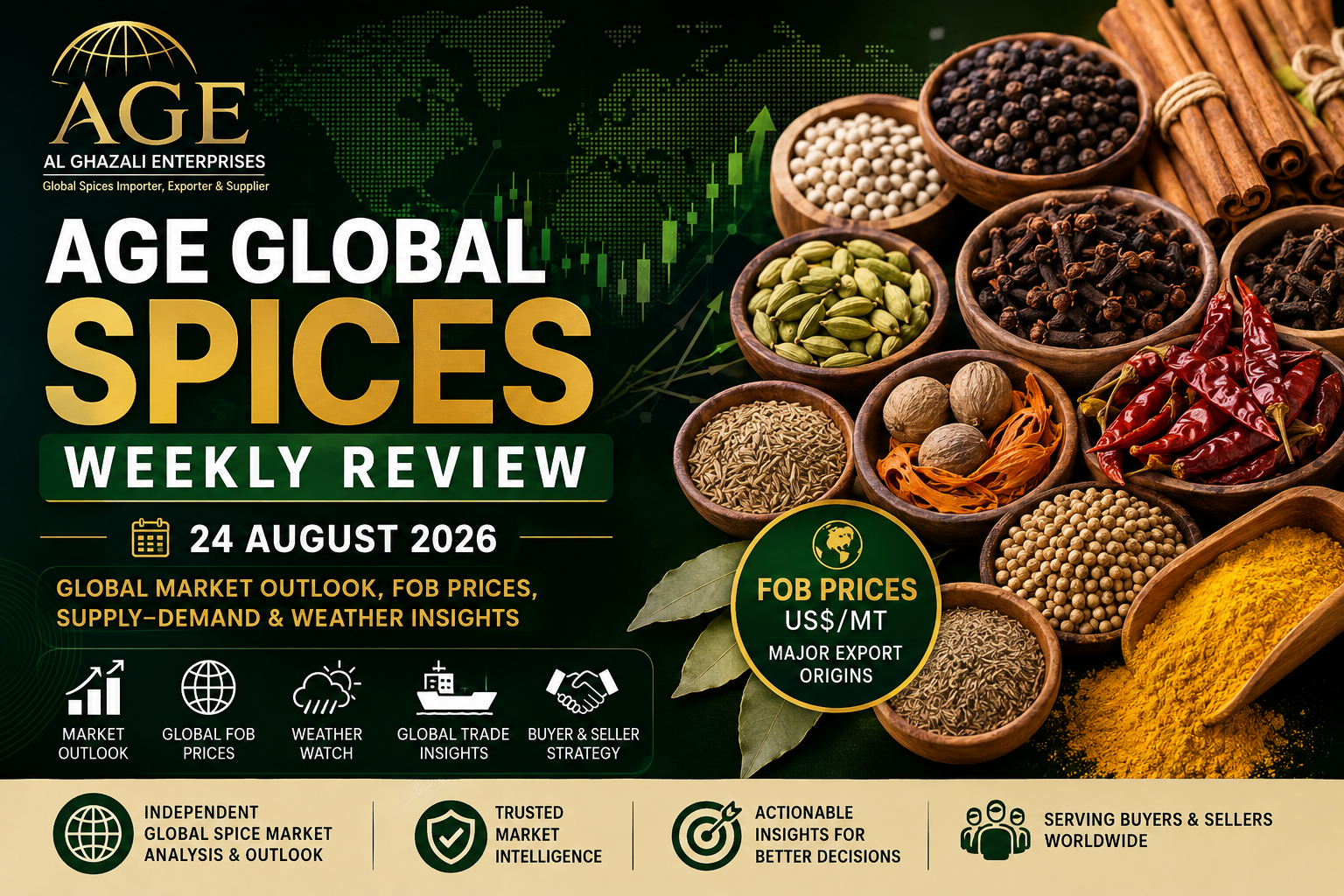
AGE GLOBAL SPICES WEEKLY REVIEW
24 August 2026
Global Market Overview
Global spice markets enter the final week of August with a mixed but increasingly cautious tone. Pepper retains the strongest underlying support among major traded spices, while cardamom has seen some price moderation as arrivals improve. Cinnamon trade remains comparatively balanced, while cloves, nutmeg, mace and several seed spices continue to be influenced more by origin-specific crop conditions, quality and availability than by a single global price trend.
The major forward risk is now weather. A strengthening El Niño could alter rainfall patterns across important producing regions in Asia, Africa and Latin America during the coming crop cycles. For buyers, this argues against relying entirely on a major future price correction.
Black Pepper — Sideways to Firm
Vietnam remains the central force in global pepper trade. Export movement through the first seven months of 2026 has remained strong, showing that international consumption continues to absorb substantial supply despite historically elevated values.
Current international indications remain differentiated by origin and grade:
- Vietnam Black Pepper: around US$5,970–6,050/MT FOB Vietnam
- Indonesia Lampung Black Pepper: around US$6,870/MT FOB Indonesia
- Indonesia Muntok White Pepper: around US$9,410/MT FOB Indonesia
- Brazil ASTA Black Pepper: broadly around the US$5,900–6,200/MT FOB Brazil depending on timing, specification and shipment terms
Brazil remains an important competitive source, although July export volumes were considerably lower than June. Indonesia remains particularly important for both black and white pepper.
AGE Direction: Sideways → Firm
Buyer View: Cover essential Q4 requirements in stages rather than waiting for a substantial market decline.
Cardamom — Near-Term Consolidation
Indian small cardamom prices have softened from some of the stronger levels recorded earlier in August as arrivals improve and buyers become more selective.
On 24 August 2026, the latest Indian auction average was approximately:
₹2,984/kg
with top lots reaching approximately:
₹3,889/kg
The market therefore remains valuable but is no longer showing uninterrupted upward momentum.
Guatemala remains strategically important to the international cardamom balance as buyers assess the next crop cycle and future export availability.
AGE Direction: Sideways / Selectively Firm
Premium green colour, bold size and clean export quality may continue to command substantial premiums over average material.
Cinnamon & Cassia — Balanced but Quality-Sensitive
Vietnam's cinnamon exports have remained broadly stable during 2026. January–July exports were approximately 73,085 MT, indicating a relatively balanced market rather than a major supply shortage.
The market must, however, be segmented correctly:
Sri Lanka: Premium Ceylon Cinnamon Vietnam: Major cassia exporter China: Important cassia producer/exporter Indonesia: Major cassia origin
Ceylon Cinnamon should not be directly price-compared with lower-cost cassia without considering botanical variety, oil characteristics, flavour profile, processing quality and destination requirements.
AGE Direction: Stable → Selectively Firm for premium specifications
Cloves — Watch Origin Supply
Indonesia remains the world's dominant clove-producing origin, while Madagascar and Tanzania/Zanzibar remain commercially important alternative suppliers.
Current market risk is less about a single headline international quotation and more about:
crop timing, farmer selling behaviour, moisture, quality, export availability and weather.
El Niño-related rainfall disruptions could become increasingly relevant to Indonesian production conditions.
AGE Direction: Stable with upside weather risk
Nutmeg & Mace — Quality Premiums Remain Important
Indonesia remains one of the world's most important nutmeg and mace origins, alongside other producing countries including Sri Lanka.
International buyers continue to differentiate strongly by:
- moisture
- aflatoxin compliance
- kernel condition
- sorting
- broken percentage
- mace colour
- food-safety certification
A low headline offer can become commercially expensive if cleaning losses or compliance problems are discovered after shipment.
AGE Direction: Stable / Quality Driven
Star Anise
Vietnam remains an important international star-anise exporter. July exports improved strongly compared with the same month last year, although cumulative 2026 shipments remain below the corresponding 2025 period.
This creates a market that is neither clearly oversupplied nor structurally tight.
AGE Direction: Stable / Origin Dependent
Turmeric, Cumin, Coriander & Chilli
Indian markets remain important price-setting references for these products.
For India, AGE will quote domestic prices in Indian Rupees only, while international/export business will be expressed in US Dollars.
Current turmeric markets show considerable variation between mandis, grades and producing regions. This makes a single national price potentially misleading.
For cumin, coriander and chilli, crop quality, arrival volumes, domestic demand and export buying remain the principal short-term drivers.
AGE Direction:
Turmeric: Mixed / Grade dependent Cumin: Mixed Coriander: Stable to mixed Chilli: Quality-driven / mixed
Weather Watch — El Niño Risk Increasing
Weather is becoming one of the most important variables for the 2026–27 spice cycle.
A strong El Niño is developing and is expected to strengthen during the coming months.
The effect will not be identical across every origin. However, potential implications include:
- irregular rainfall
- prolonged dry periods
- excessive heat
- flowering stress
- lower yields
- quality variation
- delayed harvesting
- higher production volatility
Southeast Asian origins deserve particularly close attention because of their importance to pepper, cloves, nutmeg, cassia and other tropical spices.
Origin & Trading-Hub Distinction
International buyers should carefully distinguish between:
Producing Origin → Processor/Exporter → Trading or Re-export Hub
Major hubs such as Dubai/UAE, Singapore, Hong Kong and European distribution centres play an important role in global spice trading, but shipment origin should not automatically be interpreted as agricultural origin.
Traceability becomes particularly important where food-safety, pesticide-residue, sustainability or origin declarations are required.
AGE 2–6 Week Market Outlook
Black Pepper: Sideways → Firm Cardamom: Sideways / Selectively Firm Cinnamon/Cassia: Stable Cloves: Stable with upside weather risk Nutmeg & Mace: Stable / Quality-driven Star Anise: Stable / Origin-dependent Turmeric: Mixed Cumin: Mixed Coriander: Stable → Mixed Chilli: Mixed / Quality-driven
Buyer Strategy
Buyers with confirmed consumption should consider staggered purchasing rather than trying to identify a single market bottom.
Priority should be given to:
quality-critical grades, difficult-to-replace origins, residue-compliant material and Q4 requirements where delivery timing is important.
Seller Strategy
Exporters should compete increasingly on more than price.
Traceability, laboratory compliance, consistent grading, moisture control, packing standards, documentation and reliable shipment execution can materially increase supplier competitiveness.
AGE Market View
The global spice complex is not currently presenting a uniform bullish or bearish signal.
Pepper retains a firmer underlying structure, cardamom is consolidating, cinnamon remains broadly balanced, while several other spices remain highly dependent on local crop and quality conditions.
The principal forward risk is weather.
For the coming weeks, disciplined purchasing and diversified origin sourcing remain preferable to aggressive speculative buying or prolonged procurement delays.
AGE Global Spices Weekly Review Independent Global Spice Market Analysis & Outlook Published Every Monday by Al Ghazali Enterprises
Market indications are for general market intelligence only and can vary by origin, grade, specification, volume, shipment period, Incoterm and destination.
All rights reserved by AGE.